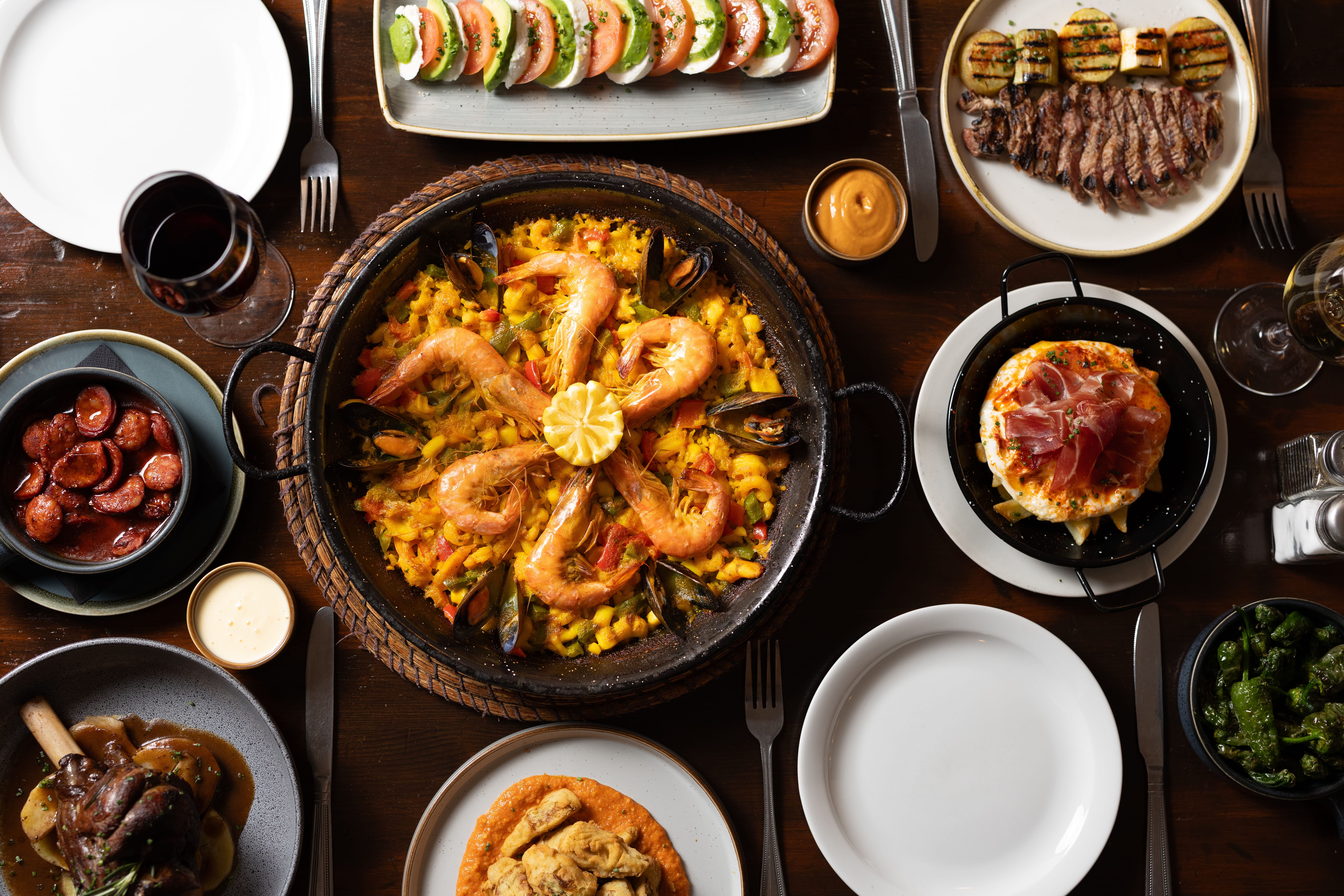
If you have ever sat down at one of our tables at Jamon Jamon and found yourself choosing between Patatas Bravas, Gambas al Ajillo, Croquetas de Jamón and Chorizo al Vino, you already understand one of the best things about tapas:
you do not have to choose just one.
Tapas are small Spanish dishes traditionally enjoyed with drinks, friends and conversation. They can be simple, like cured ham or Padrón peppers, or something warm and comforting such as croquetas, chorizo cooked in red wine or crispy potatoes covered in sauce.
But after serving Spanish food in London for more than two decades, we think describing tapas as simply “small plates” misses the most important part.
Tapas are a way of eating.
They are about putting food in the middle of the table, sharing different dishes, ordering another plate when something disappears particularly quickly and spending time together.
That is the spirit we try to recreate every day at Jamon Jamon Soho and Jamon Jamon Belsize Park, our two London restaurants.
So, what exactly are tapas, where do they come from, and what should you order if it is your first time?
Here is our guide.
What Does Tapas Mean?
The Spanish word tapa literally means a “cover” or “lid”.
The plural is tapas.
There are several stories about how the word became associated with food.
The most famous explanation says that small pieces of bread, cheese or cured ham were once placed over glasses of wine. They protected the drink from dust and insects, effectively acting as a tapa — a lid.
Over time, these simple accompaniments developed into increasingly varied small dishes.
Whether that story gives us the complete historical explanation is debatable. Different areas of Spain have their own versions of the origin of tapas.
What is much easier to recognise is what the tradition became: food, drinks and conversation enjoyed together.
And that social side of tapas is still what makes them special.
So, What Are Tapas?
Tapas are small portions of food that can be served individually or, very often, shared around the table.
There is no single ingredient or cooking technique that makes something a tapa.
A tapa can be cold or hot.
It can be as simple as slices of Jamón Ibérico, or something cooked to order like Gambas al Ajillo.
At Jamon Jamon, that variety is exactly what makes the tapas section of the menu enjoyable.
You might have the heat and garlic of sizzling prawns alongside crispy potatoes, smoky chorizo cooked in red wine, Padrón peppers and slices of Spanish ham.
The dishes are very different from each other, but they belong together because they are made to be enjoyed as part of the same shared meal.
Our current menu includes dishes such as Padrón Peppers, Huevos Rotos, Chorizo al Vino and Cordero al Horno, alongside the Spanish favourites featured throughout our restaurant menus such as Patatas Bravas and Gambas al Ajillo.
Tapas Are About Sharing
This is probably the most important thing to understand about tapas.
At Jamon Jamon, we regularly see a table begin with the intention of ordering “just a few tapas”.
Then the first dishes arrive.
Someone tries the Chorizo al Vino.
Another plate of Patatas Bravas disappears.
The prawns arrive sizzling.
And suddenly another round of dishes seems like an excellent idea.
That is how tapas should feel.
Rather than everyone concentrating on their own individual plate, the food sits at the centre of the table.
Someone passes the croquetas.
Someone takes the last Padrón pepper.
Someone asks whether anybody wants the final piece of chorizo while clearly hoping everybody says no.
The food becomes part of the conversation.
That communal style of dining is one reason tapas work so well whether you are meeting friends, going on a date or sitting down for a family meal.
Where Do Tapas Come From?
Tapas come from Spain, although there is no single restaurant, town or region that can definitively claim to have invented everything we now call tapas.
Different Spanish regions developed their own traditions of eating small dishes with drinks.
As a result, what you encounter when eating tapas in one part of Spain can be very different from what you find somewhere else.
Along the coast, seafood naturally plays a larger role.
Elsewhere you may see more cured meats, cheeses, potatoes, vegetables or slow-cooked dishes.
That variety is part of Spanish cooking.
At Jamon Jamon, we try to bring different sides of that tradition together on one menu rather than suggesting that tapas means one particular kind of food.
What Are the Most Popular Tapas?
Ask ten people for their favourite tapas and you may receive ten different answers.
But there are certain dishes we see guests returning to again and again.
Patatas Bravas
If somebody tells us they have never eaten tapas before, Patatas Bravas are an easy place to begin.
Crispy potatoes and a bold sauce make them simple, comforting and extremely shareable.
They also demonstrate something important about Spanish food: a dish does not need an enormous list of ingredients to have plenty of flavour.
At our Belsize Park restaurant, Patatas Bravas sit alongside other staples such as Jamón Ibérico and Gambas al Ajillo as part of the Spanish experience we serve.
Gambas al Ajillo
Few things create quite the same reaction at a table as prawns arriving hot with the aroma of garlic and olive oil.
Gambas al Ajillo are a classic combination of prawns and garlic, full of flavour and perfect for sharing.
And once the prawns have disappeared, you may find yourself looking around for some bread to deal with the remaining garlicky oil.
Croquetas de Jamón
A good croqueta gives you two completely different textures at once: a crisp exterior and a rich, creamy centre.
Our Croquetas de Jamón are exactly the kind of dish that makes tapas dangerous for anyone who says, “I’ll only have one.”
They are also one of the Jamon Jamon tapas we regularly feature when introducing guests to our food.
Chorizo al Vino
Our Chorizo al Vino is Spanish chorizo slow-cooked in red wine.
The result is smoky, savoury and rich — exactly the sort of dish that works well in the middle of a table alongside several contrasting tapas.
It is currently one of the dishes featured on the Jamon Jamon menu.
Padrón Peppers
Padrón peppers bring something different to the table.
At Jamon Jamon, ours are lightly pan-fried until blistered and finished with salt. They are generally mild and smoky, although every now and then you can encounter one with considerably more heat.
That occasional spicy surprise has become part of their reputation.
Sharing them also creates the possibility that somebody else at your table gets the hot one.
Which, depending on your friendships, may be considered another advantage.
Jamón Ibérico
Sometimes the simplest dishes show you the most.
Good Jamón Ibérico does not need complicated preparation. Thin slices of Spanish cured ham can be enjoyed on their own and shared slowly around the table.
Jamón has been part of the identity of Jamon Jamon from the beginning, and it remains one of the Spanish classics associated with our restaurants today.
Huevos Rotos
Our menu also includes Huevos Rotos — crispy fried potatoes topped with fried eggs that are lightly broken over the potatoes.
It is the kind of uncomplicated, satisfying food that makes sense in the middle of a table, particularly when several people can reach in and share it.
Are Tapas Starters?
They can be.
But they can also be the entire meal.
That is one of the reasons we enjoy serving tapas.
If you are coming to our Soho restaurant before a West End show, you might stop for a few tapas and a drink before heading to the theatre. Our Soho restaurant sits in the heart of the West End and regularly serves guests dining before nearby performances.
On another evening, you might sit down with friends at Belsize Park, order several rounds of tapas and stay much longer.
Or you can do what many of our guests do and start with tapas before sharing one of our paellas.
There is no requirement for tapas to fit into the traditional British idea of “starter”.
How Many Tapas Should You Order?
There is no perfect number because every dish is different and every table has a different appetite.
For two people, we normally think it makes more sense to begin with several different dishes rather than order an enormous amount immediately.
You can always add more.
That is actually one of the pleasures of tapas.
Start with Patatas Bravas.
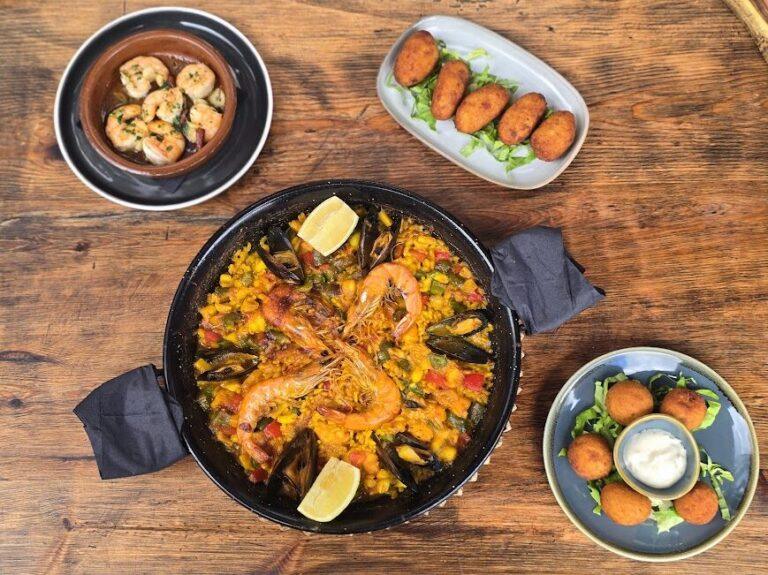
Add perhaps some Croquetas de Jamón and Gambas al Ajillo.
Try Chorizo al Vino or Padrón Peppers.
See what disappears first.
Then make the very important decision about what deserves a second plate.
For larger tables, tapas become even more fun because you can order a broader selection and everyone gets to try something different.
What Should I Order for My First Tapas Meal?
If it is your first time eating tapas at Jamon Jamon, we recommend variety rather than quantity of one particular type of dish.
A table might combine something crispy, something fresh or vegetable-based, seafood and meat.
For example, Patatas Bravas, Padrón Peppers, Croquetas de Jamón, Gambas al Ajillo and Chorizo al Vino would give you several very different flavours and textures without making the whole meal feel repetitive.
If you are still hungry afterwards, that is when a second round — or a paella for the table — becomes very tempting.
What Is the Difference Between Tapas and Pintxos?
You will often hear the words tapas and pintxos used together, particularly when talking about Spanish food.
They are related, but they are not quite the same thing.
Pintxos, or pinchos, are particularly associated with northern Spain and the Basque Country.
Many traditional pintxos consist of ingredients placed on a small piece of bread, sometimes held together with a cocktail stick.
Modern pintxos can become much more elaborate.
Tapas is a broader term and can cover many different small dishes.
So Padrón peppers, croquetas, prawns, potatoes and chorizo can all be served as tapas without needing to sit on bread or be held together with a skewer.
Do Tapas Have to Be Shared?
No tapas police will arrive if you decide not to share your Croquetas de Jamón.
But sharing is very much part of the spirit.
The beauty of ordering tapas is being able to taste several things.
When each person orders only one plate for themselves, you lose some of that experience.
Put everything in the middle instead and suddenly everyone gets prawns, potatoes, peppers, ham and chorizo.
That sounds considerably better to us.
What Do You Drink With Tapas?
Tapas and drinks have always had a close relationship.
At Jamon Jamon, sangria is naturally one of the favourites people choose alongside a table of tapas, and our restaurants also serve Spanish wines.
There is no universal pairing.
Something rich and smoky such as Chorizo al Vino calls for a different drink from garlic prawns or Jamón Ibérico.
Part of the fun is ordering several dishes and seeing what works with what you are drinking.
Most importantly, tapas are not meant to feel overly formal.
Drink what you enjoy.
Tapas or Paella?
We are going to refuse to choose.
At Jamon Jamon, tapas and paella serve two different purposes.
Tapas give you variety. You can taste several dishes and pass everything around the table.
Paella provides one larger centrepiece designed for sharing.
That is why one of our favourite ways to eat is to begin with several tapas and then share a paella.
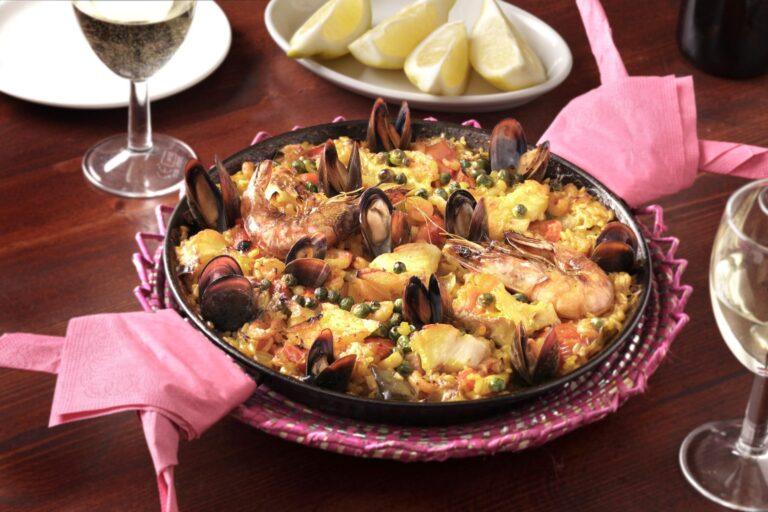
Our restaurants serve freshly prepared paellas alongside our tapas menu, including seafood paella.
It turns dinner into something you can take your time over.
Which is very much the idea.
Tapas at Jamon Jamon Soho
Our Soho restaurant is at 3 Caxton Walk, London WC2H 8PW, right in Central London.
It is particularly popular with people meeting friends in the West End, going to the theatre or simply wanting Spanish food in the middle of Soho.
Tapas work especially well here because you can make the meal as quick or as leisurely as your evening requires.
Come in before a show for Patatas Bravas, Croquetas de Jamón and Gambas al Ajillo, or settle in for a longer meal with tapas, drinks and paella.
Tapas at Jamon Jamon Belsize Park
Our Belsize Park restaurant is at 177 Haverstock Hill, London NW3 4QS.
The atmosphere is a little different from central Soho.
Belsize Park has a relaxed neighbourhood feel, and our restaurant includes outdoor dining as well as a cosy area used for smaller events.
It is exactly the kind of place where ordering a few tapas can easily turn into a long lunch or evening with friends.
And we think that is how tapas should be enjoyed.
What Are Tapas? Our Answer After More Than Two Decades of Serving Spanish Food
Yes, technically tapas are small Spanish dishes.
But after years of watching people eat them at Jamon Jamon, we think the better answer is simpler.
Tapas are food that brings the table together.
They give you an excuse to order something you have never tried before.
They mean you can have prawns and potatoes and chorizo rather than choosing between them.
They slow the meal down.
They encourage conversation.
And they almost always result in somebody asking:
“Should we order one more?”
We normally think the answer is yes.
Come and Try Tapas at Jamon Jamon
The easiest way to understand tapas is not to read another definition.
It is to sit down and eat them.
Join us at Jamon Jamon Soho or Jamon Jamon Belsize Park and build your own table of Spanish flavours.
Start with Patatas Bravas.
Add the Gambas al Ajillo.
Order some Croquetas de Jamón, Padrón Peppers or Chorizo al Vino.
Share everything.
And if you are still hungry, there is always paella.